

How Long Does It Take To Learn Affiliate Marketing: Beginner’s Guide
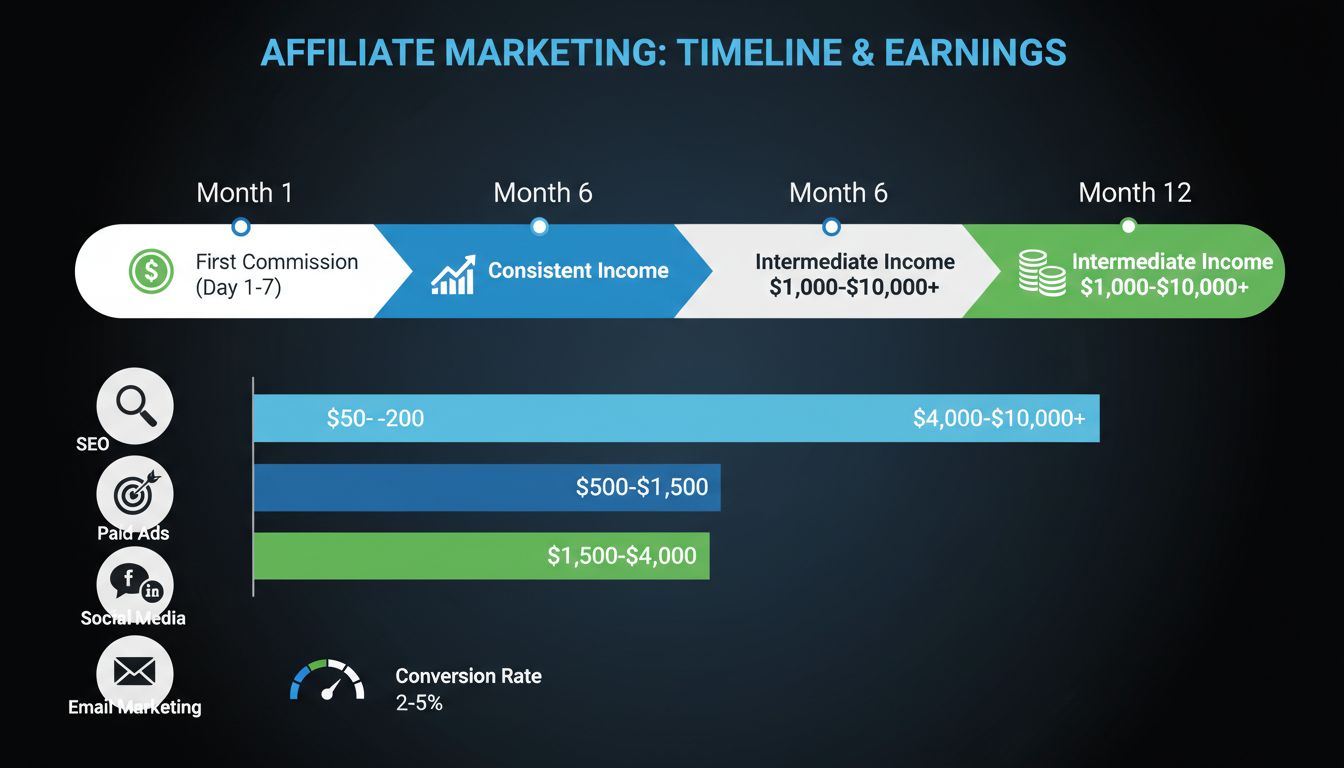
For most people in the United States, it takes one to three months to learn the basics of affiliate marketing and about six to 12 months to build a reliable system. Earning a first commission may happen within a few months, but income is not guaranteed.
Your timeline depends on your platform, topic, available time, marketing skills, traffic source, and ability to publish useful content consistently. Someone working 10 hours per week may progress much faster than someone who studies for one hour each weekend.
There is no official study that proves one fixed learning period. The time frames in this guide are practical planning estimates, not promises of income.

The Short Answer: How Long Does Affiliate Marketing Take to Learn?
You can understand the basic ideas in one to four weeks. You may need one to three months to launch a simple affiliate project. Building steady traffic and income often takes six to 18 months.
Here is a realistic planning guide:
| Stage | Typical time | What you can do |
|---|---|---|
| Basic understanding | 1–2 weeks | Explain affiliate links, commissions, merchants, and tracking |
| Beginner setup | 2–6 weeks | Choose a topic, build a platform, and join suitable programs |
| First useful content | 1–3 months | Publish articles, videos, emails, or social posts that help users |
| First commission | 2–6 months | Possible if you find relevant traffic and promote the right offers |
| Consistent traffic | 6–12 months | Build a repeatable content and promotion process |
| More advanced growth | 12–24 months | Improve conversion rates, email marketing, analytics, and partnerships |
These ranges can vary widely. A beginner with an existing audience may earn sooner. A new website that relies mainly on organic Google traffic may need more time because search visibility usually develops gradually.
Affiliate marketing is not a single skill. It combines:
- Audience research
- Content creation
- Search engine optimization
- Email marketing
- Social media promotion
- Website management
- Offer selection
- Performance tracking
- Advertising compliance
Learning the first few skills is usually quick. Learning how they work together takes longer.
What Does “Learning Affiliate Marketing” Mean?
Learning affiliate marketing means knowing how to recommend a product or service through a tracked link and earn a commission when a qualifying action takes place.
The main parties are:
- The merchant — the company that sells the product or service.
- The affiliate — the person or business that promotes it.
- The affiliate network or program — the system that tracks clicks, leads, and sales.
- The customer — the person who takes the tracked action.
For example, a website about home office equipment may link to a desk sold by a retailer. If a visitor clicks the link and buys the desk under the program’s rules, the website may receive a commission.
The affiliate does not usually handle inventory, shipping, customer service, or product fulfillment. However, the affiliate is responsible for publishing truthful content, following program rules, and making required disclosures.
In the United States, the Federal Trade Commission says that a material connection should be disclosed clearly and conspicuously. A short statement such as “I may earn a commission if you buy through my link” can help, but the disclosure must be easy to notice and understand. Review the FTC’s endorsement guidance for current information.
The Main Factors That Change Your Learning Speed
Your available time matters, but it is not the only factor. The platform, business model, and feedback cycle can change your timeline by months.
Your starting skills
You may learn faster if you already know how to:
- Write clear articles
- Record or edit video
- Use social media
- Build a website
- Read basic analytics
- Compare products
- Sell or explain ideas
A complete beginner may need extra time to learn terms such as conversion rate, search intent, cookie duration, attribution, and commission structure.
Your traffic source
Different channels have different learning curves.
| Traffic source | Early learning curve | Main challenge |
|---|---|---|
| Search-based website | Moderate to high | Creating useful content and earning visibility |
| YouTube | Moderate | Making helpful videos and gaining watch time |
| Email marketing | Moderate | Building a permission-based list |
| Social media | Low to moderate | Publishing consistently and earning attention |
| Paid advertising | High | Managing costs, tracking results, and avoiding losses |
| Online community | Moderate | Building trust without spamming |
Paid advertising can produce traffic quickly, but it also creates financial risk. A beginner can lose money before learning how to measure clicks, leads, sales, and return on ad spend.
Organic content may cost less in direct cash, but it usually takes more time. This is why “fast” and “easy” are not the same thing.
Your topic or niche
A broad topic such as “technology” may offer many products but also intense competition. A narrow topic such as “standing desks for small apartments” may make it easier to create focused content.
A good topic usually has:
- Products that genuinely help the audience
- Enough questions to support useful content
- Clear customer needs
- Programs with understandable terms
- Products you can discuss accurately
Avoid choosing a topic only because it appears profitable. If you cannot understand the products or help the audience, content quality will suffer.
Your content output
Publishing one strong piece of content each week gives you more chances to learn than publishing one piece every two months.
Quality still matters. Ten weak articles may teach you less than three carefully researched articles with clear search intent, original comparisons, and useful explanations.
Your feedback loop
You learn faster when you review real signals:
- Which pages receive impressions?
- Which videos hold attention?
- Which links receive clicks?
- Which offers produce sales?
- Where do visitors leave?
- Which questions do readers ask?
Without measurement, you may repeat the same mistake for months.
A Practical 90-Day Affiliate Marketing Learning Plan
A 90-day plan gives a new affiliate marketer enough time to learn, launch, and review early results without expecting instant income.
Days 1–30: Learn and choose a direction
Start with the business model rather than a product list.
Learn:
- How affiliate links work
- How commissions are recorded
- What a conversion means
- How different programs set their terms
- How disclosures work in the United States
- How to identify a real audience problem
Then choose one main channel. A website, YouTube channel, email list, and social account can all work, but starting with all of them may spread your effort too thin.
During this stage:
- Choose one audience.
- Select one focused topic.
- List 20 to 50 questions that audience asks.
- Research products that solve those problems.
- Read each affiliate program’s terms.
- Create a simple publishing plan.
Do not apply to every program at once. First check whether the program fits your audience, content, location, payment rules, and promotional methods.
Days 31–60: Build and publish
Create the basic platform and publish helpful material.
For a website, this may include:
- A clear homepage
- An About page
- A contact method
- A privacy policy
- An affiliate disclosure
- Several useful guides
- Relevant comparison or review pages
For YouTube, it may include:
- A clear channel topic
- Helpful videos that answer specific questions
- Accurate titles and descriptions
- A disclosure in suitable locations
Your early goal is not to sound like a large company. Your goal is to become useful to a specific audience.
Explain who a product fits, who should avoid it, what it costs when relevant, what limitations exist, and what alternatives may make sense. Avoid claims you cannot verify.
Days 61–90: Measure and improve
Review performance rather than guessing.
Useful measures include:
- Page views or video views
- Search impressions
- Click-through rate
- Affiliate link clicks
- Conversion rate
- Earnings per click
- Email sign-ups
- Refunds or canceled orders
A simple calculation can show where the problem sits:
Estimated commission = qualifying sales × commission per sale
For example, if 10 people buy a product and the commission is $8 per sale, the estimated commission is $80 before adjustments such as refunds or program-specific rules.
Another useful calculation is:
Conversion rate = qualifying sales ÷ affiliate link clicks × 100
If 200 people click a link and four complete a qualifying purchase, the conversion rate is 2%.
These numbers do not prove that a page will perform the same way next month. They help you decide whether to improve the content, change the offer, or seek better traffic.

When Can You Expect Your First Affiliate Commission?
Many beginners can potentially earn a first commission within two to six months, but some take longer and others never earn one. The main issue is not the number of days since launch. It is whether the project has relevant traffic and a useful offer.
A first commission is more likely when:
- The audience has a clear buying problem
- The content answers that problem well
- The product matches the problem
- The link works correctly
- The program accepts your traffic source
- Visitors trust the recommendation
- The purchase process is simple
A page that attracts 1,000 visitors who are only seeking free information may earn less than a page that attracts 100 visitors ready to compare products.
Search intent is the reason behind a query. Someone searching “what is a standing desk” may be learning. Someone searching “best standing desk for a small office” may be comparing options. Someone searching for a specific model may be close to buying.
You do not need to force every page into a sales pitch. Educational content can build trust and bring future readers. Commercial content can help users make a purchase decision. A healthy site may include both.
How Long Does It Take to Make Consistent Affiliate Income?
Consistent affiliate income often takes six to 18 months, especially when starting without an audience. This is a planning range, not a result that every marketer should expect.
Income becomes more stable when you have:
- Several traffic sources
- Multiple useful content assets
- More than one suitable merchant
- Reliable tracking
- A clear update process
- An audience that returns
- Offers that continue to meet user needs
Affiliate income can change from month to month. A merchant may lower its commission, end a program, change its terms, or stop selling a product. Search traffic can also change. A social platform can change its distribution system.
For this reason, avoid relying on one product, one keyword, or one traffic source.
It also helps to separate revenue from profit. Revenue is the amount earned from commissions. Profit is what remains after expenses such as hosting, software, contractors, content production, advertising, and taxes.
U.S. creators and businesses should keep clear records and review current IRS guidance or speak with a tax professional about their situation. Tax treatment can depend on business structure, income level, expenses, and location.

What Should You Learn First?
Learn the skills that help you make good decisions before advanced tactics.
1. Audience and problem research
Find out what people need, what confuses them, and what they compare before buying. Use customer questions, product documentation, retailer reviews, forums, support pages, and keyword research as discovery tools.
A question found in a forum shows that someone asked it. It does not prove that every reader has the same need or that a product solves it.
2. Clear content
Good affiliate content does more than repeat a product description. It should help the reader decide.
Useful formats include:
- Product comparisons
- Buying guides
- Tutorials
- Alternatives
- Case-based explanations
- “Best for” articles with clear limits
- Setup and troubleshooting guides
Do not claim to have tested a product unless you actually tested it. If you rely on manufacturer information, say so.
3. Basic SEO
Search engine optimization helps people find content through search engines. At a beginner level, focus on:
- Matching the page to the search intent
- Writing a clear title
- Answering the question early
- Using useful headings
- Linking related pages
- Improving page speed and usability
- Updating outdated information
- Avoiding copied or thin content
Google’s SEO Starter Guide explains several basic principles. No SEO guide can guarantee rankings.
4. Tracking and analytics
Learn what each number means before trying to improve it.
For example:
- Low impressions may suggest weak demand, poor visibility, or a new page.
- Impressions with few clicks may suggest a title or topic problem.
- Many clicks with no sales may suggest an offer, trust, price, or tracking problem.
- Sales with low profit may suggest high operating costs.
The same symptom can have more than one cause. Change one major factor at a time when possible.
5. Compliance and disclosure
Affiliate relationships should be clear to the audience. Place disclosures where readers can see them before they make a decision based on the recommendation.
Also review:
- Affiliate program rules
- Email marketing requirements
- Advertising rules
- Platform policies
- Copyright limits
- Privacy obligations
- Local and federal tax guidance
The rules can change. Use current official sources for decisions that affect your business.

A Weekly Study and Work Schedule
You do not need to work full time to learn affiliate marketing. A simple schedule can create steady progress.
If you have five hours per week
- One hour: study one skill
- Two hours: research audience questions
- One hour: create or improve content
- One hour: review traffic and clicks
At this pace, expect a slower launch. You may need several months to build a useful content base.
If you have 10 hours per week
- Two hours: research
- Four hours: create content
- Two hours: promote or distribute it
- One hour: review data
- One hour: improve your process
This schedule can support a 90-day launch plan.
If you have 20 or more hours per week
More time can speed up production, but only if the work is focused. Publishing more content will not fix a poor topic, weak offers, broken tracking, or unclear writing.
Use extra time for research, editing, measurement, and updates rather than producing large amounts of low-value content.
Common Reasons Affiliate Marketers Take Longer Than Expected
The most common delay is not a lack of motivation. It is working on the wrong task.
Expecting instant passive income
Affiliate marketing can become more efficient over time, but it is not automatically passive. Content needs updates. Links can break. Programs can change. Audiences need ongoing help.
Choosing a topic based only on commission size
A high commission does not matter if the product is a poor fit or the audience does not trust the recommendation.
Promoting too many products
A long list of links can confuse readers. Start with products that clearly solve the problem discussed on the page.
Ignoring program terms
Programs may limit advertising methods, brand-name bidding, email promotion, coupon use, or geographic traffic. Read the terms before promoting.
Buying expensive training too early
A paid course may provide structure, but it cannot replace practice, research, useful content, or traffic. Before buying, check the curriculum, refund terms, update date, instructor qualifications, and independent reviews.
Using paid ads before understanding the numbers
Advertising can magnify a profitable system, but it can also magnify losses. Learn tracking and set a strict test budget before spending significant money.
Copying product descriptions
Copied text gives readers little new information and may create quality or copyright concerns. Add your own analysis, comparison, instructions, or decision help.
Failing to disclose affiliate links
A hidden relationship can damage trust and may create compliance problems. Use clear language and follow current FTC guidance.

How to Tell Whether Your Plan Is Working
Affiliate marketing may be progressing even before it produces meaningful income.
Early signs include:
- More relevant search impressions
- Increasing visitors to useful pages
- Higher-quality comments or questions
- More email sign-ups
- Affiliate links receiving clicks
- Better engagement with product comparisons
- Some sales from more than one page
- Returning visitors
If you have traffic but no clicks, review the match between the page and the offer. If you have clicks but no sales, check the product fit, tracking, price, customer trust, and program rules.
If you have no traffic, do not immediately change every affiliate link. First review the topic, content quality, distribution method, and time since publication.
Set a review date, such as every 30 days. This prevents daily data from controlling every decision.
Affiliate Marketing Learning Timeline by Business Model
The business model you choose affects the time needed to learn.
| Model | Learning time | Potential advantage | Main limitation |
|---|---|---|---|
| SEO website | 3–12 months to build momentum | Content can attract search traffic over time | Results may be slow and uncertain |
| YouTube affiliate content | 2–6 months for early feedback | Demonstrations can build trust | Video skills and consistency matter |
| Social media affiliate content | 1–3 months to learn the basics | Fast feedback on topics | Reach can change quickly |
| Email affiliate marketing | 2–6 months | Direct access to subscribers | You need permission and a useful list |
| Paid search or social ads | 1–3 months to learn basics | Traffic can arrive quickly | Mistakes can cost real money |
| Influencer partnerships | Varies widely | Existing audiences can respond quickly | Trust and audience fit are essential |
These are not income forecasts. They describe the approximate time needed to learn the basic operating process.
Frequently Asked Questions
Can I learn affiliate marketing in 30 days?
You can learn the basic process and launch a small project in 30 days. You may not have enough data to judge long-term performance. Use the first month to learn, publish, and set up tracking rather than expecting dependable income.
Is affiliate marketing easy for beginners?
The basic concept is simple, but building traffic and trust is not always easy. Beginners must learn content, audience research, promotion, measurement, and compliance. The process becomes more manageable when you focus on one audience and one primary channel.
Do I need a website to start affiliate marketing?
No. Some people use YouTube, email, social media, podcasts, or other channels. A website gives you more control over your content, but it also requires maintenance. Check each program’s rules before using a specific traffic source.
How much money do I need to start?
The required budget can range from very little to a large amount. Free platforms may reduce upfront costs, while a website may require hosting, a domain, and tools. Paid advertising requires a separate risk budget. Do not spend money you cannot afford to lose.
Can affiliate marketing replace a full-time job?
It can produce meaningful income for some businesses, but results vary and are not guaranteed. Do not leave stable employment based on early commissions alone. Consider income consistency, expenses, taxes, savings, and the risk of program or traffic changes.
Should I learn SEO or social media first?
Choose the channel that matches your strengths and audience. SEO may suit people who enjoy research and writing. Social media may suit people who prefer short-form content and direct interaction. You can add another channel after you understand the first one.
A Simple Next Step
Set aside the next seven days to choose one audience, one topic, and one traffic channel. List 20 questions that audience asks, select three questions you can answer well, and check whether suitable affiliate programs exist.
Then publish one genuinely useful piece of content with a clear disclosure. Track impressions, visitors, link clicks, and questions. Treat the first 90 days as a learning and testing period, not a promise of income.
Conclusion
Most beginners can learn the basics of affiliate marketing in one to three months. Building steady traffic and income usually takes six to 18 months, and some projects will need more time or will not become profitable.
The fastest sustainable path is not to chase every trend. Choose a focused audience, solve real problems, publish useful content, follow U.S. disclosure rules, measure results, and improve one part of the system at a time.


