

How To Do Keyword Research For Affiliate Marketing: Step-by-Step Guide
Introduction
If you publish an affiliate website for readers in the United States, keyword research helps you find the words people use before they compare, choose, or buy a product. The best process is not to chase the largest search volume. It is to find topics with clear buyer intent, realistic competition, useful products, and enough value for you to earn a reader’s trust.
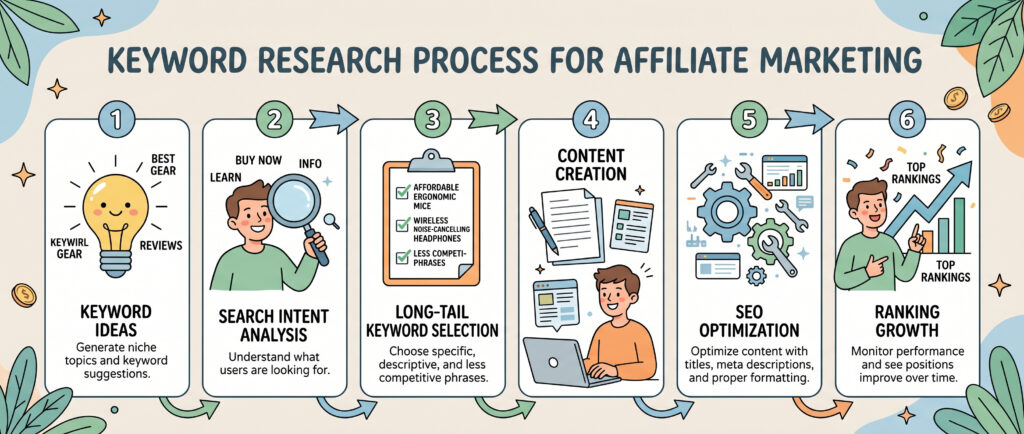
Start by listing products your audience may need. Then collect real search terms, group them by intent, check the results in Google, estimate the business value, and choose topics you can cover better than the current pages. Finally, build helpful content that clearly explains your affiliate relationship and follows U.S. advertising rules.
What Is Keyword Research for Affiliate Marketing?
Keyword research is the process of finding and assessing search terms that people use in search engines. For affiliate marketing, the goal is more specific: find terms that connect a reader with a product, service, or buying decision.
A useful keyword usually has four traits:
- It matches a real problem or need.
- It shows a clear stage in the buying process.
- It relates to a product with a suitable affiliate program.
- It offers a realistic chance to create a better page.
For example, “running shoes” is broad. A term such as “best running shoes for flat feet” gives more detail. “Brooks Adrenaline vs ASICS Gel-Kayano” shows that the reader is comparing two products. “ASICS Gel-Kayano women’s size 8” may show an even stronger buying signal.
Search volume alone does not tell you whether a keyword is valuable. A small group of people searching for a specific product may be more useful than a large group looking for general information.
The main keyword intent types
Search intent is the reason behind a query. Affiliate content often works best when it serves commercial investigation or transactional intent, but informational terms can also support the path to a purchase.
| Intent | Example keyword | What the reader may want | Suitable content |
|---|---|---|---|
| Informational | how to choose a laptop | Learn the basics | Buying guide |
| Problem-solving | laptop keeps overheating | Fix a problem | Tutorial with product options |
| Commercial investigation | best laptops for college | Compare choices | Roundup or comparison |
| Comparison | MacBook Air vs Dell XPS | Pick between products | Comparison article |
| Transactional | buy noise-canceling headphones | Take action | Product page or focused review |
| Navigational | Anker Soundcore official site | Find a known brand or site | Usually not a priority for affiliates |
A query can have more than one intent. “Best budget air purifier for a bedroom” asks for recommendations, but it also includes limits on price and use.
Keyword, topic, and page are not the same
A keyword is a search phrase. A topic is the wider subject behind related phrases. A page is the content asset you publish.
For example:
- Keyword: “best office chair for back pain”
- Related keywords: “ergonomic office chair,” “chair with lumbar support,” and “best desk chair for long hours”
- Topic: choosing an office chair for comfort and support
- Page: a detailed buying guide with product comparisons
Do not create one thin page for every minor wording change. Group close variants when they have the same intent and deserve the same answer.
How to Find Affiliate Keywords Step by Step
The most reliable approach combines audience research, search results, keyword tools, and product checks. Use the steps below in order.
1. Choose a focused affiliate niche
Begin with a market where you can provide useful advice. A focused niche makes it easier to understand the reader, judge products, and build related content.
Good starting questions include:
- What problem does the audience have?
- Which products help solve it?
- Do those products have legitimate affiliate programs?
- Can you explain the topic with care and accuracy?
- Can you cover a clear subtopic instead of a broad market?
For example, “home products” is too broad for a new site. “Quiet air purifiers for small apartments” gives you a clearer reader, use case, and product set.
Avoid choosing a niche only because it has expensive products. High prices do not guarantee commissions, conversions, or reader trust. Some areas also need extra care. Health, legal, financial, and safety products can require current evidence and careful wording.
2. Build a seed keyword list
Seed keywords are short phrases that describe your niche. They help you discover longer, more specific searches.
Use several sources:
- Product categories
- Common customer problems
- Product features
- Use cases
- Audience types
- Brands and models
- Alternatives and substitutes
- Questions from support teams or sales staff
- Reviews on large retail sites
- Search suggestions in Google
- “People also ask” questions
- Search Console data, if you already have a site
For a home coffee niche, seed terms might include:
- espresso machine
- coffee grinder
- pour-over coffee
- coffee maker for office
- espresso machine under $500
- grinder for light roast beans
Do not treat every suggestion as a good target. At this stage, you are collecting language, not choosing final keywords.
3. Expand the list with keyword research tools
You can use free sources or paid tools. The tool matters less than how you interpret the data.
Useful options include:
- Google Search suggestions: Shows common ways people complete a query.
- Google Trends: Helps compare interest over time and across U.S. locations. It does not provide exact search volume.
- Google Keyword Planner: Provides estimates designed for advertising research. Treat them as estimates, not exact organic demand.
- Google Search Console: Shows queries that already produce impressions or clicks for your site.
- Ahrefs, Semrush, Moz, and similar tools: Can provide keyword ideas, estimated volume, competition metrics, and ranking-page data. These figures are third-party estimates.
- Retailer search bars: Reveal product language used by shoppers.
- Community discussions: Help you find problems and wording. They do not prove search volume or product quality.
Export your ideas into a spreadsheet. At minimum, include:
| Column | Purpose |
|---|---|
| Keyword | The exact phrase |
| Topic group | The wider subject |
| Intent | Informational, comparison, or transactional |
| Product or service | The affiliate offer it may support |
| Search estimate | Source and date |
| Competition | Tool estimate plus manual review |
| Business value | Low, medium, or high |
| Content type | Guide, review, comparison, or tutorial |
| Notes | Questions, risks, and content gaps |
Record the tool and date for numerical data. Search estimates can change by country, device, season, and tool.
4. Add long-tail keywords
Long-tail keywords are usually more specific phrases. They often have fewer searches than broad terms, but they can reveal a clearer need.
Examples:
- “best trail running shoes for wide feet”
- “best portable monitor for MacBook Air”
- “quiet blender for apartment living”
- “best budget camera for YouTube beginners”
Specific terms can help you understand the reader’s constraints. Those constraints may include:
- Price
- Size
- Skill level
- Location
- Compatibility
- Material
- Use environment
- Age or audience
- Performance need
- Accessibility need
Do not assume that every long phrase is easy to rank for. Some specific terms still have strong competition, especially when they include popular products or brands.
5. Classify every keyword by intent
Read the query as if you were the searcher. Ask what answer would satisfy the person.
A useful classification system is:
- Learn: The person needs basic information.
- Solve: The person has a problem.
- Compare: The person is deciding between options.
- Choose: The person wants recommendations.
- Buy: The person appears ready to take action.
- Find: The person wants a specific website or brand.
Affiliate sites can cover all of these, but each needs a different page format. A “how to clean a cast-iron skillet” article should not read like a sales page. A “best cast-iron skillet” guide should compare products and explain selection criteria.
6. Check the search results manually
A keyword tool cannot replace a manual review of Google results. Search the phrase in the United States, ideally in a private browser window or with location settings that match your audience.
Examine:
- The types of pages ranking
- The age and quality of the content
- The products mentioned
- The page format
- The depth of the answers
- The use of firsthand testing
- The clarity of the recommendations
- Missing conditions or use cases
- Whether major retailers dominate the results
- Whether the results match the query’s intent
Look for a content gap, not just a weak-looking competitor. A useful gap may be:
- No clear answer for a specific audience
- No comparison of important features
- Outdated product information
- Poor explanation of trade-offs
- Missing setup or compatibility details
- No transparent method for choosing products
- Recommendations that ignore price or availability
Do not assume a page is poor because it is short. A short page may satisfy a narrow query well. Judge it against the user’s task.
7. Connect each keyword to an affiliate offer
A keyword is not automatically valuable because it mentions a product. Check the commercial path before writing.
Review:
- Whether a suitable affiliate program exists
- Commission rules
- Cookie or attribution terms
- Allowed promotional methods
- Brand bidding restrictions
- Geographic limits
- Return or cancellation rules
- Payment threshold
- Product availability in the United States
- Whether the program has a direct relationship with the merchant
Program terms change. Check the current agreement before relying on a commission, duration, or payout claim.
A keyword can still be worth covering without an affiliate offer. It may attract the right audience and lead to later content. However, do not build an entire business plan around commissions that you have not verified.
8. Group keywords into content clusters
Place related terms into groups based on shared intent. Each group should usually have one primary page.
Example cluster:
Main topic: best portable monitors for remote work
- portable monitor for laptop
- best second monitor for travel
- USB-C portable monitor
- portable monitor for MacBook
- portable monitor with HDMI
- portable monitor for remote work
The main page can cover the broad buying decision. Separate pages may be useful when the intent changes, such as:
- How to connect a portable monitor to a laptop
- USB-C monitor compatibility guide
- Portable monitor comparison for MacBook users
Use internal links to connect these pages. Keep the links useful and descriptive rather than forcing the same anchor text repeatedly.

How to Choose the Best Affiliate Keywords
The best affiliate keywords balance reader value, commercial relevance, competition, and your ability to create a strong page.
Use a simple scoring model
You can rank keywords with a basic worksheet. This is a planning aid, not a scientific score.
Rate each factor from 1 to 5:
- Intent: How close is the reader to a product decision?
- Product fit: How well does the query match a real offer?
- Audience fit: How closely does it match your site?
- Content opportunity: Can you add useful information?
- Competition: How difficult do the current results appear?
- Trust burden: How much evidence or care does the topic require?
A simple priority formula could be:
Priority = intent + product fit + audience fit + content opportunity − competition − trust burden
This formula is hypothetical. Its purpose is to make your choices clear and consistent. It does not predict traffic, rankings, or earnings.
Consider commercial value without overvaluing it
Commercial value depends on more than commission rate. Consider:
- The chance that the reader will buy
- The price of the product
- The commission structure
- The merchant’s reputation
- The product’s return rate
- The level of competition
- The usefulness of the product to your audience
- The time needed to create and update the content
A high-commission product may create poor reader outcomes if it does not fit the query. Short-term earnings should not outweigh accuracy and trust.
Give more weight to real constraints
A keyword with a clear constraint often supports better content. For instance, “best office chair” is broad. “Best office chair for a short person under $300” gives you specific criteria.
You can turn those criteria into a review method:
- List the reader’s needs.
- Define how a product meets each need.
- Verify specifications from reliable sources.
- Separate documented facts from your judgment.
- Explain who should and should not choose each option.
- State any limits, extra costs, or setup issues.
If you have not tested a product, do not imply that you have. You can summarize documented specifications and reported user experiences, but label those sources accurately.
Choose the right content format
| Keyword pattern | Strong format |
|---|---|
| best [product] for [audience] | Buying guide |
| [product A] vs [product B] | Comparison |
| [product] review | Review with a clear evidence method |
| how to use [product] | Tutorial |
| [product] alternatives | Alternatives guide |
| [product] size or compatibility | Explainer |
| [problem] caused by [product] | Troubleshooting guide |
The format should match the result the reader wants. A comparison query needs a comparison. A repair query needs useful steps before product recommendations.

How to Estimate Keyword Difficulty
Keyword difficulty is the effort needed to compete for a search term. No third-party score can measure it perfectly.
Use three forms of evidence together:
- Tool estimates: Helpful for sorting a large list.
- Search-result review: Shows what content actually competes.
- Your own site strength: Affects what is realistic for your domain.
Check the ranking pages for:
- Relevant content
- Strong product knowledge
- Clear page structure
- Original images or testing
- Trusted links and sources
- Fresh product details
- Good answers to follow-up questions
- Brand or retailer authority
A result page full of major retailers may be difficult for a new affiliate site. That does not mean you must avoid the topic. A narrower angle may be more realistic, such as a specific use case, price range, or audience.
Avoid treating domain authority as a fixed rule. Search engines evaluate pages and sites in many ways, and third-party authority scores are not official Google metrics.
A practical difficulty review
Classify a keyword as:
- Low opportunity: The results already answer the query well, and your site has no clear advantage.
- Possible opportunity: Some pages are useful, but important details or audiences are missing.
- Strong opportunity: The results do not fully satisfy the intent, and you can provide a more complete, accurate answer.
- High-risk opportunity: The topic requires evidence, testing, or professional review that you cannot provide.
Start with possible or strong opportunities that fit your resources. A small site can often build trust faster by covering a narrow group of related questions well.

How to Use Search Volume, Trends, and Click Data
Search volume is useful for comparison, but it is not a promise of traffic. Different tools use different data sources, models, countries, and time periods.
Search volume
Use volume to compare similar terms. Do not treat an estimate as an exact count of future visitors.
For example, if two terms have similar intent and one has a larger estimate, it may deserve earlier review. But a lower-volume term may still be better if it has stronger purchase intent and less competition.
Google Trends
Google Trends can help you identify:
- Seasonal interest
- Regional differences within the United States
- Rising or declining attention
- Related topics
- Differences between similar terms
Trends uses relative interest, not a direct count of searches. A score of 100 means the highest point in the selected comparison, time range, and location. It does not mean 100 searches.
Search Console
If your site already receives impressions, Search Console can reveal:
- Queries where your page appears
- Terms with impressions but few clicks
- Pages that rank for unexpected topics
- Queries that may deserve new sections
- Terms that could support a separate page
Use the data to improve an existing page when the intent is close. Create a new page only when the query needs a different answer.
Click potential
Some searches receive fewer organic clicks because the answer appears directly in the results, or because ads, local listings, shopping results, and large brand features take attention.
Ask:
- Does the reader need a detailed explanation?
- Will the reader likely compare products?
- Does the query suggest a visit to a specific brand?
- Can your page add value beyond a short answer?
A keyword can have strong commercial value even if its raw search volume is modest. The key is whether your page can help the reader make a sound decision.

Keyword Research Example for a U.S. Affiliate Site
Imagine a site for people who work from small home offices. You want to promote desks, chairs, lighting, and monitor accessories.
Seed terms
Start with:
- home office chair
- compact desk
- desk lamp
- monitor stand
- standing desk converter
Expanded terms
After using search suggestions, tools, and result reviews, you may find:
- best compact desk for a small room
- best office chair for long hours
- monitor stand for a narrow desk
- desk lamp that does not cause glare
- standing desk converter for a small workspace
Evaluate one keyword
Consider “best monitor stand for a narrow desk.”
- Intent: Commercial investigation
- Audience: People with limited desk space
- Product fit: Strong
- Content angle: Compare width, height, weight limit, storage, and cable space
- Potential issue: Measurements and compatibility must be checked carefully
- Useful follow-up: How to measure a desk before buying a monitor stand
This topic is stronger than a general “best monitor stand” article if you can explain the space limits clearly.
Plan the article
A useful page could include:
- A direct recommendation framework
- A table of product dimensions
- Guidance on monitor size and weight
- Differences between risers, arms, and shelves
- Cable management limits
- Stability and installation details
- Who should avoid each type
- A measurement checklist
- Affiliate disclosure
- Links to related setup guides
The value comes from helping the reader avoid a poor fit. The affiliate link should support the decision, not replace it.

Common Keyword Research Mistakes
Chasing only high-volume keywords
Broad terms often attract strong competitors and mixed intent. A smaller topic with clear needs may produce a better first page.
Ignoring the product before choosing the keyword
Do not build content around a keyword and check monetization later. Confirm that relevant products and compliant programs exist.
Creating one page for every variation
Several phrases may describe the same task. Combine them when the intent and answer are the same. Split them when the reader needs a different format or decision.
Copying competitor headings
Use competing pages for research, not as a template to rewrite. Add your own structure, evidence, examples, and decision rules.
Treating keyword tools as facts
Keyword difficulty, volume, traffic potential, and conversion estimates are often modeled. Label them as estimates and use manual judgment.
Ignoring U.S. disclosure rules
The Federal Trade Commission says affiliate relationships should be disclosed clearly and conspicuously when they could affect how people evaluate an endorsement. The disclosure should be easy to notice and understand.
A short disclosure near the relevant content may be clearer than a vague statement hidden in a footer. Do not claim that you personally used or tested a product unless that is true. See the FTC Endorsement Guides for current guidance.
Making health or safety claims without proper support
Claims about health effects, child safety, electrical safety, or financial outcomes need extra care. Use current, suitable sources and avoid turning general information into personal advice.
Forgetting content updates
Affiliate pages can become inaccurate when prices, models, features, stock, warranties, and program terms change. Set a review schedule based on how quickly the topic changes.

A Keyword Research Workflow You Can Repeat
Use this short workflow for each new affiliate topic:
- Choose a focused audience and product problem.
- Write 10 to 20 seed terms.
- Expand them with search suggestions, tools, and customer language.
- Record each term, source, country, and date.
- Classify the intent.
- Group similar terms by the answer they need.
- Check the U.S. search results manually.
- Review product fit and affiliate program rules.
- Score the content opportunity.
- Select a primary keyword and related terms.
- Choose the correct page format.
- Write for the reader’s decision, not for a keyword count.
- Add clear disclosures and source links.
- Publish only when the page answers the full task.
- Review performance and update the page when evidence changes.
Signs the process is working
Look for useful signals, such as:
- Your page receives impressions for related terms.
- Searchers stay long enough to use the content.
- Readers click relevant product links.
- Visitors move to comparison or buying pages.
- Search Console reveals new, related queries.
- Readers ask questions that show real engagement.
- Product information remains accurate after review.
These signals do not prove that a page will rank or earn a specific amount. They help you decide what to improve.
What to do when a keyword does not perform
First, identify the problem:
- No impressions: The topic may be too competitive, too new, poorly targeted, or not well indexed.
- Impressions but few clicks: The title or result appearance may not match the query.
- Clicks but quick exits: The page may not answer the intent or may load poorly.
- Engagement but no affiliate clicks: The product path may be unclear or poorly matched.
- Affiliate clicks but no sales: The offer, price, merchant, or reader intent may not fit.
Change one major factor at a time when possible. Review the search results again before rewriting the page. Do not add repeated keywords simply because traffic is low.

Frequently Asked Questions
How many keywords should an affiliate article target?
Choose one main topic and cover its close variants naturally. A long guide may rank for many related terms without targeting each phrase separately. The right number depends on how many questions belong to the same intent.
Are low-volume keywords worth targeting?
They can be. A low-volume term may show a specific need, strong product intent, or a useful audience segment. Check the search results and the product fit before deciding.
Should affiliate sites target informational keywords?
Yes, when the information supports the reader’s buying path or solves a related problem. Informational content can build trust and introduce products, but it should not force a sales pitch where one does not belong.
Which keyword research tool is best?
No single tool is best for every site. Free Google sources can reveal real wording and search behavior. Paid tools can make large-scale comparison easier. Use the tool as an estimate, then confirm intent and competition by reviewing the actual U.S. search results.
How often should affiliate keyword research be updated?
Review it when products, search behavior, affiliate terms, or important regulations change. For fast-moving categories such as electronics, software, travel, and online services, review pages more often than stable categories. Always recheck details before making a current claim.
Conclusion
Effective affiliate keyword research starts with the reader’s problem, not a keyword list. Find specific needs, classify intent, inspect the U.S. results, verify product and affiliate fit, and choose topics where you can add clear evidence and useful guidance.
Use search volume as one clue. Give greater weight to intent, audience fit, content quality, and your ability to keep product information accurate. Then publish pages that help readers make informed choices, disclose affiliate relationships clearly, and improve as you learn from real search data.


