

What Are The Responsibilities Of Marketing: Key Roles Explained
Marketing is responsible for helping an organization understand its customers, offer useful products or services, communicate value, and support business growth. In the United States, marketing teams may also manage brand strategy, market research, advertising, content, public relations, customer data, digital channels, and performance measurement.
Marketing is more than promotion. It connects customer needs with business goals. A strong marketing team helps a company decide who to serve, what to offer, how to reach people, and how to measure results.
What Is Marketing?
Marketing is the process of identifying customer needs, creating value, communicating that value, and supporting exchanges between an organization and its customers.
The American Marketing Association defines marketing as activities and processes used to create, communicate, deliver, and exchange offerings that have value for customers, clients, partners, and society. This broad definition explains why marketing includes much more than ads or social media.
Marketing often works across the full customer journey:
- Awareness: Helping people discover a company or product
- Consideration: Giving people reasons to compare and evaluate an offer
- Purchase: Supporting the decision to buy
- Retention: Encouraging repeat purchases and continued use
- Advocacy: Helping satisfied customers recommend the brand
The exact responsibilities vary by company size, industry, business model, and budget. A small U.S. business may assign all marketing work to one person. A large company may divide the work among research, product marketing, brand, media, content, analytics, public relations, and customer marketing teams.

What Are the Main Responsibilities of Marketing?
The main responsibilities of marketing are to research the market, understand customers, guide the offer, build a clear position, communicate with audiences, generate demand, support sales, retain customers, and measure business results.
1. Conducting Market Research
Market research helps a business make decisions based on evidence rather than assumptions. Marketing teams study customers, competitors, market conditions, buying habits, and unmet needs.
Common research activities include:
- Customer surveys and interviews
- Focus groups
- Website and search data analysis
- Competitor reviews
- Social media listening
- Sales team feedback
- Customer support records
- Industry reports and public data
- Tests of messages, prices, or offers
Research should answer practical questions:
- Who is most likely to buy?
- What problem are they trying to solve?
- What alternatives do they use now?
- What stops them from buying?
- Which benefits matter most?
- How do they describe the problem in their own words?
Marketing research does not remove uncertainty. It reduces avoidable guesswork and gives leaders better information for product, pricing, sales, and communication decisions.
2. Identifying Target Customers
Marketing helps a company decide which groups deserve attention. This process is called targeting.
A target market may be defined by:
- Location
- Age or life stage
- Business size
- Industry
- Job role
- Income or budget
- Interests
- Buying behavior
- Customer needs
- Use case
A buyer persona is a practical description of a typical customer. It may include goals, concerns, buying triggers, preferred channels, and common objections. A persona should reflect real research, not a fictional character created from stereotypes.
Marketing also uses segmentation, which divides a broad market into smaller groups with shared traits or needs. For example, a software company may serve small businesses, mid-sized firms, and enterprise customers with different pricing, features, and buying processes.
3. Creating the Value Proposition
A value proposition explains why a customer should choose one offer over another. It connects a customer need with a specific benefit.
A useful value proposition answers three questions:
- Who is the product or service for?
- What problem does it solve?
- Why is it a useful choice compared with available alternatives?
For example:
A bookkeeping service helps small U.S. businesses organize financial records and prepare for tax season without hiring a full-time accounting team.
This statement is clearer than a vague claim such as “We provide world-class financial solutions.”
Marketing may help shape the value proposition, but the claim must match the actual product or service. Marketing cannot fix a poor customer experience by changing the wording alone.
4. Supporting Product and Service Decisions
Marketing teams often share customer and market insights with product managers, service teams, and company leaders. Their research can influence:
- Product features
- Service design
- Packaging
- Naming
- Product updates
- Onboarding
- Customer education
- Product-market fit
Marketing does not always own the product roadmap. However, it can show what customers need, what competitors offer, and where buyers face confusion.
In a customer-centered business, marketing receives feedback from the market and helps move it into the organization.
5. Developing Brand Strategy
Brand strategy defines how an organization wants to be understood and remembered. It includes more than a logo or color palette.
Brand responsibilities may include:
- Brand purpose
- Positioning
- Voice and tone
- Visual identity
- Brand promises
- Messaging standards
- Reputation management
- Consistency across channels
A brand is shaped by every customer interaction, including an advertisement, sales call, website, invoice, product experience, and support response.
Marketing may guide brand standards, but every department affects the brand. A campaign cannot create lasting trust if the product fails to deliver the promised value.
6. Creating Marketing Content
Content marketing gives customers useful information before, during, and after a purchase. Content may include:
- Website pages
- Blog articles
- Videos
- Guides
- Case studies
- Email messages
- Product documentation
- Webinars
- Social posts
- Sales presentations
- Research reports
Good content should serve a clear audience and purpose. It may explain a problem, compare options, answer questions, demonstrate a product, or help customers use a service.
Marketing teams should check content for accuracy, accessibility, clarity, copyright concerns, and compliance. Content should not make claims that the business cannot support.
7. Managing Advertising and Promotion
Advertising places a paid message in front of a selected audience. Marketing teams may plan, create, buy, and measure campaigns across channels such as:
- Search advertising
- Display advertising
- Social media advertising
- Streaming video
- Radio
- Direct mail
- Sponsorships
- Events
- Out-of-home media
Promotion can create awareness and demand, but paid reach does not guarantee results. Performance depends on the audience, offer, message, timing, landing page, sales process, and customer experience.
In the United States, advertising claims must be truthful and supported by evidence. The Federal Trade Commission states that advertising must not be deceptive or unfair. Marketing teams should involve legal or compliance staff when campaigns include health, financial, environmental, safety, pricing, or performance claims.
8. Managing Digital Channels
Digital marketing includes the online channels used to attract, inform, convert, and retain customers. These may include:
- Search engine optimization
- Email marketing
- Company websites
- Social media
- Online communities
- Mobile apps
- Digital public relations
- Online events
- Marketing automation
Channel selection should follow customer behavior and business goals. A company does not need to use every platform. A channel is useful when the intended audience uses it and the organization can maintain it well.
For example, a local home repair company may gain more from local search, reviews, referrals, and a clear service website than from posting daily on several social platforms.
9. Generating and Nurturing Leads
In many B2B and high-consideration businesses, marketing helps generate potential customers, often called leads.
Lead-generation activities may include:
- Educational downloads
- Webinars
- Contact forms
- Free trials
- Product demonstrations
- Events
- Search campaigns
- Referral programs
- Email subscriptions
Lead nurturing gives potential buyers useful information over time. It may include educational emails, case studies, product comparisons, and answers to common objections.
Marketing and sales should agree on what counts as a qualified lead. Otherwise, marketing may focus on large numbers while sales receives contacts that are unlikely to buy.
10. Supporting Sales
Marketing supports sales by helping potential customers understand the problem, the solution, and the reasons to act.
Sales support may include:
- Product brochures
- Presentation decks
- Case studies
- Competitive information
- Pricing explanations
- Email templates
- Training
- Lead scoring
- Account-based marketing
- Customer proof and testimonials
Marketing should listen to sales calls and review lost-deal feedback when possible. These sources can reveal questions that website content and advertising fail to answer.
The strongest relationship between marketing and sales is based on shared goals, clear definitions, and regular feedback. Marketing should not be judged only by lead volume, and sales should not be expected to fix unclear positioning alone.
11. Retaining and Growing Customers
Marketing responsibilities continue after the sale. Retention marketing helps customers receive value and choose to stay.
Retention activities may include:
- Onboarding campaigns
- Product education
- Customer newsletters
- Usage reminders
- Loyalty programs
- Renewal communication
- Cross-selling
- Upselling
- Customer communities
- Satisfaction surveys
Retention is especially important for subscription businesses. A company may acquire many customers but still lose money if those customers leave quickly.
Marketing must avoid treating customers as targets for endless promotions. Helpful retention communication should make the product easier to use and show customers how to reach their goals.
12. Measuring Marketing Performance
Marketing measurement connects activities with outcomes. Common metrics include:
- Reach
- Impressions
- Website visits
- Engagement
- Click-through rate
- Conversion rate
- Leads
- Qualified leads
- Sales revenue
- Customer acquisition cost
- Return on ad spend
- Customer retention
- Churn
- Customer lifetime value
Each metric answers a different question. For example, reach shows how many people may have seen a message. It does not show whether they understood it or bought anything.
Marketing teams should define the goal before choosing the metric. A campaign designed to build awareness may use different measures from a campaign designed to generate online sales.
A simple conversion-rate calculation is:
[
\text{Conversion Rate} = \frac{\text{Number of Conversions}}{\text{Number of Relevant Visitors or Responders}} \times 100
]
Hypothetical example: If 50 of 1,000 qualified website visitors request a consultation, the conversion rate is 5%.
The denominator matters. A conversion rate based on qualified visitors is not directly comparable with one based on all website traffic.
13. Managing Marketing Budgets
Marketing teams plan how to use limited resources. A budget may cover:
- Staff
- Agencies
- Advertising
- Software
- Research
- Events
- Content production
- Design
- Public relations
- Sponsorships
- Training
Budget decisions should reflect business goals, sales cycles, margins, and available evidence. A campaign that appears profitable may not be sustainable if it ignores staff time, fulfillment costs, discounts, or customer service costs.
Marketing should also track spending against planned results and adjust when assumptions change.
14. Protecting Customer Trust and Privacy
Marketing teams handle personal information, customer feedback, purchase data, and online behavior. Responsible marketing uses only the data needed for a clear purpose and follows applicable law and company policy.
U.S. requirements can vary by state, industry, channel, and type of data. The CAN-SPAM Act applies to commercial email, while state privacy laws may create additional obligations. Marketing teams should coordinate with legal, privacy, security, and information technology teams rather than assuming one rule covers every campaign.
Good practices include:
- Explain what data is collected and why
- Use permission where required
- Honor unsubscribe requests
- Protect customer records
- Avoid sensitive targeting without proper review
- Keep claims accurate
- Label sponsored or paid content clearly
- Check testimonials and endorsements
- Limit access to marketing data
Trust is a marketing asset, but it is also a responsibility.

What Does Marketing Do in Different Types of Businesses?
Marketing performs similar core functions across industries, but the daily work changes with the business model.
| Business type | Common marketing focus | Typical measures |
|---|---|---|
| Local business | Local visibility, reviews, referrals, promotions | Calls, visits, bookings, revenue |
| E-commerce company | Product discovery, conversion, repeat orders | Conversion rate, average order value, repeat purchase rate |
| B2B company | Education, lead generation, sales support | Qualified pipeline, sales opportunities, revenue |
| Subscription business | Acquisition, onboarding, retention | Trial conversion, churn, recurring revenue |
| Nonprofit organization | Awareness, donations, volunteers, community support | Donors, donations, participation, retention |
| Public agency | Public information and service use | Reach, understanding, applications, service access |
A restaurant, software company, hospital, nonprofit, and manufacturer may all use marketing. Their audiences, rules, buying cycles, and measures are different.
Marketing also changes by customer type:
- B2C marketing often reaches individuals who make faster decisions.
- B2B marketing may involve several decision-makers and longer sales cycles.
- Direct-to-consumer marketing may manage the whole path from advertising to delivery.
- Channel marketing may support distributors, retailers, dealers, or partners.
The best marketing plan reflects how customers actually make decisions.

How Do Marketing and Other Departments Work Together?
Marketing works best when it shares information with other departments instead of operating alone.
Marketing and Sales
Marketing attracts and educates potential buyers. Sales has direct conversations with prospects and often handles complex decisions. The teams should share definitions, customer feedback, pipeline data, and revenue goals.
Marketing and Product
Product teams build or improve the offer. Marketing brings customer research, competitor information, positioning, and launch plans. Product teams help marketing understand what the product can and cannot do.
Marketing and Customer Service
Customer service sees recurring problems and questions. Marketing can turn those insights into clearer content, better onboarding, and more accurate campaigns.
Marketing and Finance
Finance helps evaluate budgets, margins, revenue, and return on investment. Marketing needs financial context to avoid treating revenue as the same thing as profit.
Marketing and Legal or Compliance
Legal and compliance teams help review claims, contracts, promotions, privacy practices, endorsements, and industry rules. Early review is usually more efficient than changing a campaign after launch.
Marketing and Leadership
Company leaders set broad goals. Marketing turns those goals into customer, market, brand, and growth plans. Leadership should provide clear priorities so marketing does not chase disconnected activities.

What Skills Are Needed for a Marketing Career?
Marketing roles require a mix of business, communication, creative, analytical, and technical skills.
Useful skills include:
- Customer research
- Writing and editing
- Presentation
- Strategic planning
- Data analysis
- Search marketing
- Paid media
- Email marketing
- Social media management
- Project management
- Budget planning
- Brand development
- Negotiation
- Collaboration
- Ethical decision-making
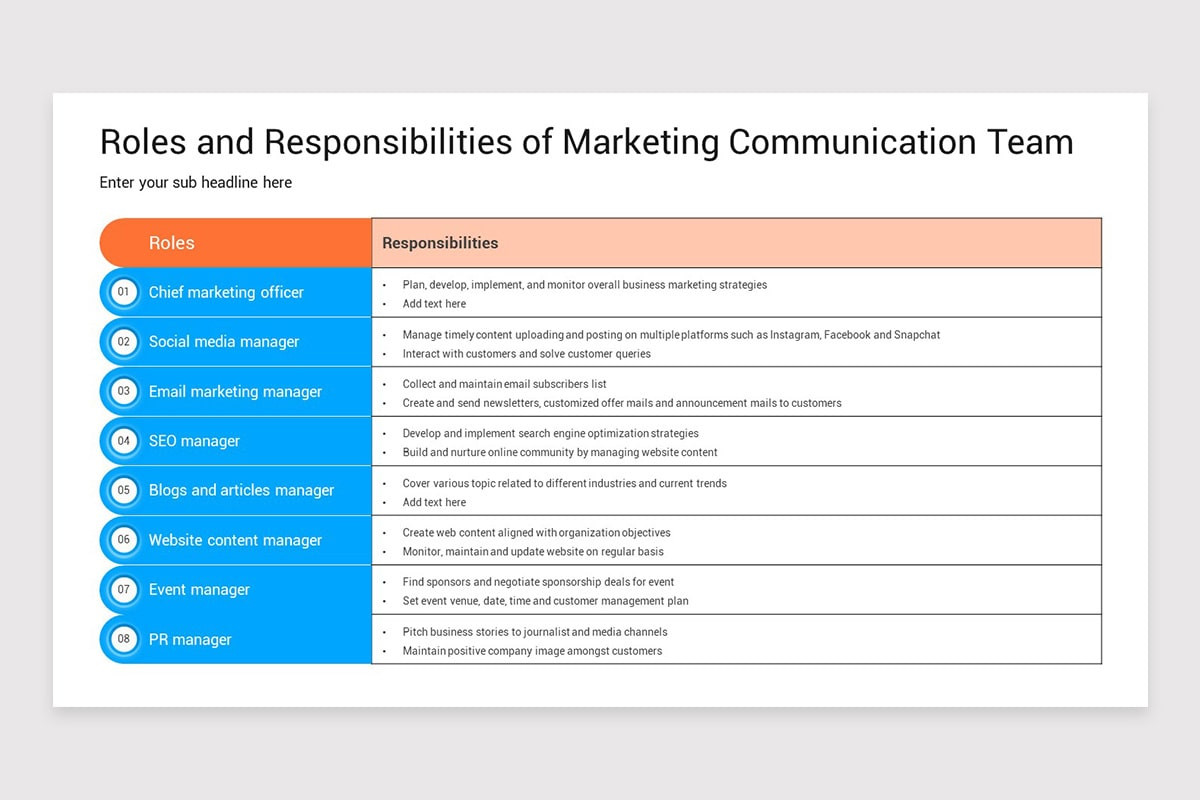
Not every marketer needs advanced skill in every area. A marketing analyst may focus on data, while a copywriter may focus on language. A marketing manager often needs enough knowledge to coordinate specialists and connect their work to business goals.
The most valuable skill is often judgment: knowing which customer problem matters, which evidence is reliable, which channel fits the audience, and which result is worth the cost.
How Can a Small Business Organize Its Marketing Responsibilities?
A small business can begin with a simple system rather than trying to use every marketing channel.
Step 1: Define the business goal
Choose one clear goal, such as:
- Increase qualified inquiries
- Sell more of a specific product
- Improve repeat purchases
- Enter a new local market
- Reduce customer churn
Step 2: Describe the best-fit customer
Write down the customer’s need, location, budget, buying trigger, and main concern. Use real customer conversations when possible.
Step 3: Clarify the offer
State what the business provides, who it helps, and what makes the offer useful. Remove vague promises that cannot be proven.
Step 4: Select a few suitable channels
Choose channels based on customer behavior and available time. A small business may start with a website, email list, local search profile, referral process, or one social channel.
Step 5: Create a basic measurement plan
Track a few meaningful numbers:
- Qualified inquiries
- Sales
- Revenue
- Cost per inquiry
- Repeat purchases
- Customer feedback
Step 6: Review results on a regular schedule
Review results monthly or at a pace that fits the sales cycle. Keep activities that support the goal, change weak activities, and stop work that has no clear purpose.
This approach helps prevent a common mistake: confusing activity with progress.
Common Mistakes in Marketing Responsibilities
Marketing problems often come from unclear goals, weak evidence, or poor coordination.
Focusing only on promotion
Advertising cannot replace product quality, fair pricing, good service, or reliable delivery. Marketing should address the full customer experience.
Measuring attention instead of business value
Likes, views, and clicks may be useful signals, but they are not always business outcomes. Connect channel metrics with qualified actions and revenue where possible.
Trying to reach everyone
Broad audiences can make messages vague and budgets inefficient. A clear target group usually makes it easier to choose a message and channel.
Copying competitors
A competitor’s campaign may not fit a different audience, budget, product, or market position. Use competitor research as context, not as a complete strategy.
Making unsupported claims
Claims about savings, performance, health, safety, environmental impact, or customer results need appropriate evidence. Testimonials do not automatically prove that most customers will achieve the same outcome.
Ignoring existing customers
Acquiring customers can receive too much attention while onboarding, service, and retention receive too little. Customers who do not receive value are unlikely to remain loyal.
Collecting too much data
More data is not always better. Excess data can create privacy risk, storage costs, and confusion. Collect information that supports a defined business purpose.
Treating SEO as a substitute for useful content
Search optimization can help people find a page. It cannot make inaccurate, thin, or unhelpful information valuable. The content must answer the user’s question clearly.

How Is Marketing Success Evaluated?
Marketing success should be evaluated against the original objective and the customer’s stage in the buying journey.
A useful evaluation asks:
- What was the business goal?
- Which audience did the campaign reach?
- What action did the audience take?
- What did the activity cost?
- What revenue, retention, or customer value followed?
- What other factors may have influenced the result?
- What should change next time?
Marketing results can be difficult to measure because customers often interact with several channels before buying. A person may see an ad, read a review, visit a website, speak with sales, and then purchase later.
For this reason, marketers should avoid claiming that one channel caused every result unless the measurement method supports that conclusion. Attribution reports can inform decisions, but they are estimates shaped by the data and model used.
A balanced dashboard often includes:
- Business outcomes
- Customer outcomes
- Channel performance
- Cost and efficiency
- Quality indicators
- Long-term retention
Frequently Asked Questions About Marketing Responsibilities
Is marketing the same as advertising?
No. Advertising is one part of marketing. Marketing also includes research, positioning, product input, pricing support, content, sales support, customer retention, analytics, and brand management.
Who is responsible for marketing in a company?
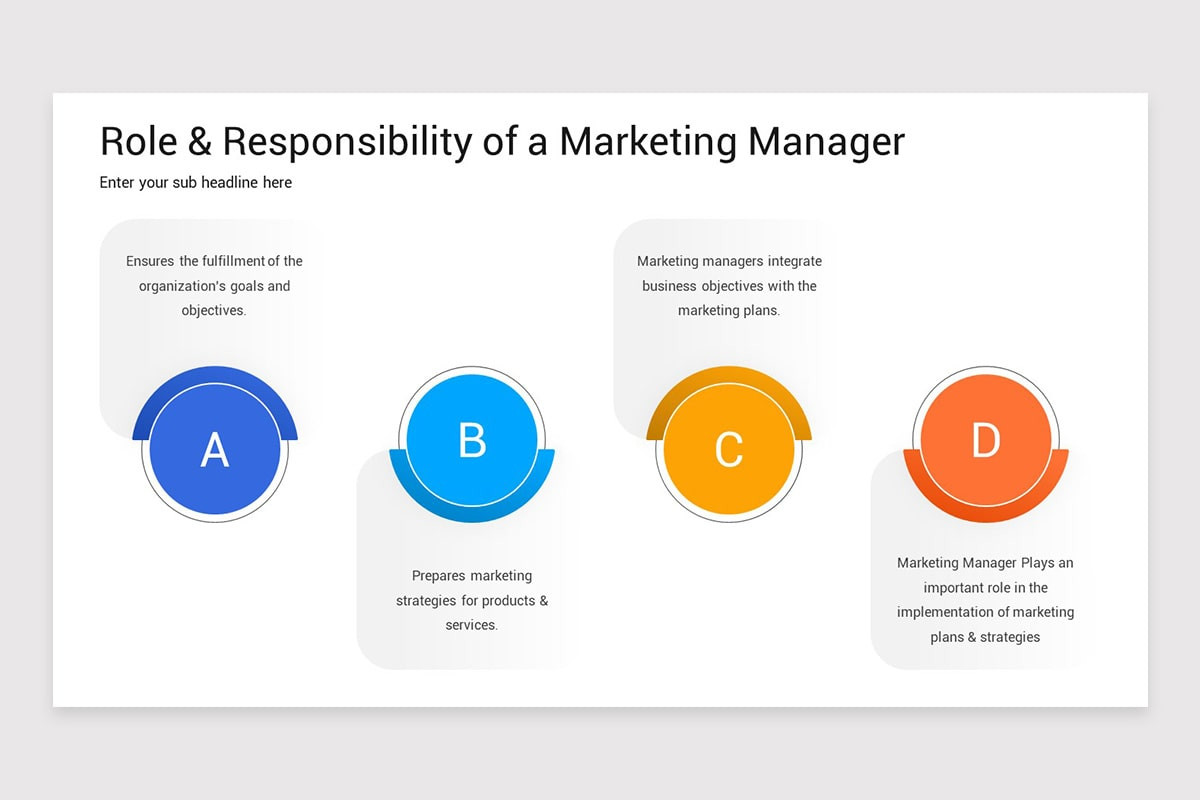
Responsibility may belong to a marketing manager, chief marketing officer, owner, agency, or specialist team. However, sales, product, customer service, and leadership also influence the customer experience and brand.
What is the most important responsibility of marketing?
The most important responsibility is connecting customer needs with business value in a truthful and useful way. The specific priority may be awareness, sales, retention, market research, or brand trust, depending on the organization’s goal.
What is the difference between marketing and sales?
Marketing usually creates awareness, interest, education, and demand. Sales usually works directly with qualified prospects to guide a purchase. The two functions overlap and should share information and goals.
Does every business need a marketing department?
Not every business needs a separate department. Every business does need marketing responsibilities to be handled. In a small company, the owner or a generalist may manage them. Larger organizations often use specialized teams.
What should a beginner learn first in marketing?
A beginner should learn customer research, clear writing, basic business metrics, ethical advertising, channel selection, and how to connect marketing activity with customer and business outcomes.
Key Takeaways
- Marketing identifies customer needs and helps an organization create and communicate value.
- Core marketing responsibilities include research, targeting, positioning, content, promotion, sales support, retention, and measurement.
- Marketing is broader than advertising or social media.
- The right responsibilities depend on the organization’s industry, audience, business model, and goals.
- Marketing teams should work closely with sales, product, service, finance, legal, and leadership.
- Useful measurement connects marketing activity with customer behavior, revenue, retention, and cost.
- Responsible marketing protects privacy, uses accurate claims, and builds trust over time.
Conclusion
The responsibilities of marketing cover the full relationship between an organization and its customers. Marketing finds and understands the audience, shapes the offer, explains its value, supports the buying process, and learns from results.
A practical next step is to list your organization’s marketing activities under four headings: understand the customer, create value, communicate value, and measure results. This simple view can reveal missing responsibilities and show where marketing work is disconnected from business goals.


